

Permian Basin & Southeast New Mexico
The hard cleaning jobs. Fewer hours, safer work.
Confined space and vessel cleaning, hydro excavation and line jetting, pond and pit cleanup, and pressure washing, for oil and gas, sand plants, and chemical plants. Eight years. Zero recordables.
Why operators and plants call us
Six reasons to put Gentex on your location
Most tank cleaning still means a hot, hazardous vessel, hand tools, and a line of trucks on the pad. We take the hazard down before anyone touches it, clean it with or without entry, and do it with fewer units sitting on your location, which is what makes the job safer and cheaper at the same time.
Non-entry first. Entry only when the vessel requires it
Most vessels do not need a person inside them. Frac tanks, ISOs, tankers, and production tanks are usually cleaned end to end from the outside: no permit, no attendant, nobody exposed. Some jobs still call for an entry: a vessel that has to come back cleaner than a wash alone will get it, or a tank like an AST or a Poseidon that has to be closed out from the inside. When that is the job, our certified crews make the entry, but never before any H2S, LELs, or benzene in the space are treated with 509 and the bulk of the material is knocked down from the outside. What is left is a short entry instead of a shift-long crawl with hand tools. Less time inside is less exposure, and it is fewer hours on the invoice too.
The 509 treatment, when the atmosphere calls for it
A confined space carries several kinds of risk at once: heat, footing, and restricted access. The atmosphere is the one that can put a person down before anybody reaches them. H2S, LELs, and benzene are the worst of it, and where any of them are present our 509 treatment breaks them down before work begins, on oilfield vessels and industrial ones alike. Gentex is a 509 distributor: we sell it to customers, and on our own jobs it goes on whenever it is needed, whether a crew is going in or staying out. The rest of the hazards get managed the way they should be: analysis, monitoring, PPE, and a supervisor on the location.
Solids other trucks leave behind
Settled solids that a standard vacuum truck cannot lift, we can. And where the location has somewhere to put them, such as an open-top pit, a frac tank, or the pond itself, our units can offload right there instead of running the truck to a disposal to unload. When that is available, it means fewer trips through your gate, less trucking on the invoice, and a job that keeps moving. When it is not, the material gets hauled away by vacuum truck or roll-off, depending on what the site requires.
Supervisor on every job
A Gentex supervisor is on location for the whole job, not dispatched from town after something has gone wrong. One person is accountable for the scope, the safety, and the result, so decisions get made on location without waiting on a call to the office.
Every job documented, start to finish
We run our own field operations and dispatch software, built for how this work actually goes. Crews are dispatched and tracked from the yard to the location, and the job is logged as it happens: scope, safety checks, and the condition of the work when the crew walks away. That means faster turnarounds for you, and a documented record that the safety and quality you were promised were actually met.
Transparent pricing
You get the scope and the number up front, in plain language. No surprise line items, no padded hours on the invoice, and nothing cut out of the scope to make the number look better.
What we do
Services
Cleaning, excavation, and support work for oil and gas, chemical plants, and industrial facilities across the Permian Basin and Southeast New Mexico.
Confined Space & Vessel Cleaning
Entry-certified crews on ASTs, Poseidon and frac tanks, ISOs, tankers, mixers, and industrial vessels, cleaned from the outside wherever the vessel allows it, and where an entry is required, knocked down from the outside first so the time inside is short.
See the service →
Hydro Excavation & Line Services
Hydro excavation, daylighting, potholing, and line locating on in-ground utilities and pipelines, plus line jetting up to 1,500 ft and blockage removal on pipelines and plant piping. Water moves the dirt, so the line stays where it is, uncovered and undamaged, and there is no repair crew behind us.
See the service →
Site & Environmental Cleanup
Frac pond cleaning, pit cleans, containment, cellar clean-outs, sand plant cleanup, and SWD cleanouts, with purpose-built equipment that handles the whole job, from the initial JSA to the final walk-through, including the settled solids most trucks cannot lift.
See the service →
Washing & Pressure Services
Plant, facility, and equipment pressure washing, pneumatic cleaning, and rig wash, done around your operation instead of shutting it down.
See the service →
Equipment & Support
Roustabouts, clean/drift/tally, tanker and ISO pickup & dropoff, vac box roll-offs for sludge, and skid steer work, with one supervisor over the whole scope and fewer vendors to mobilize.
See the service →
Built in-house
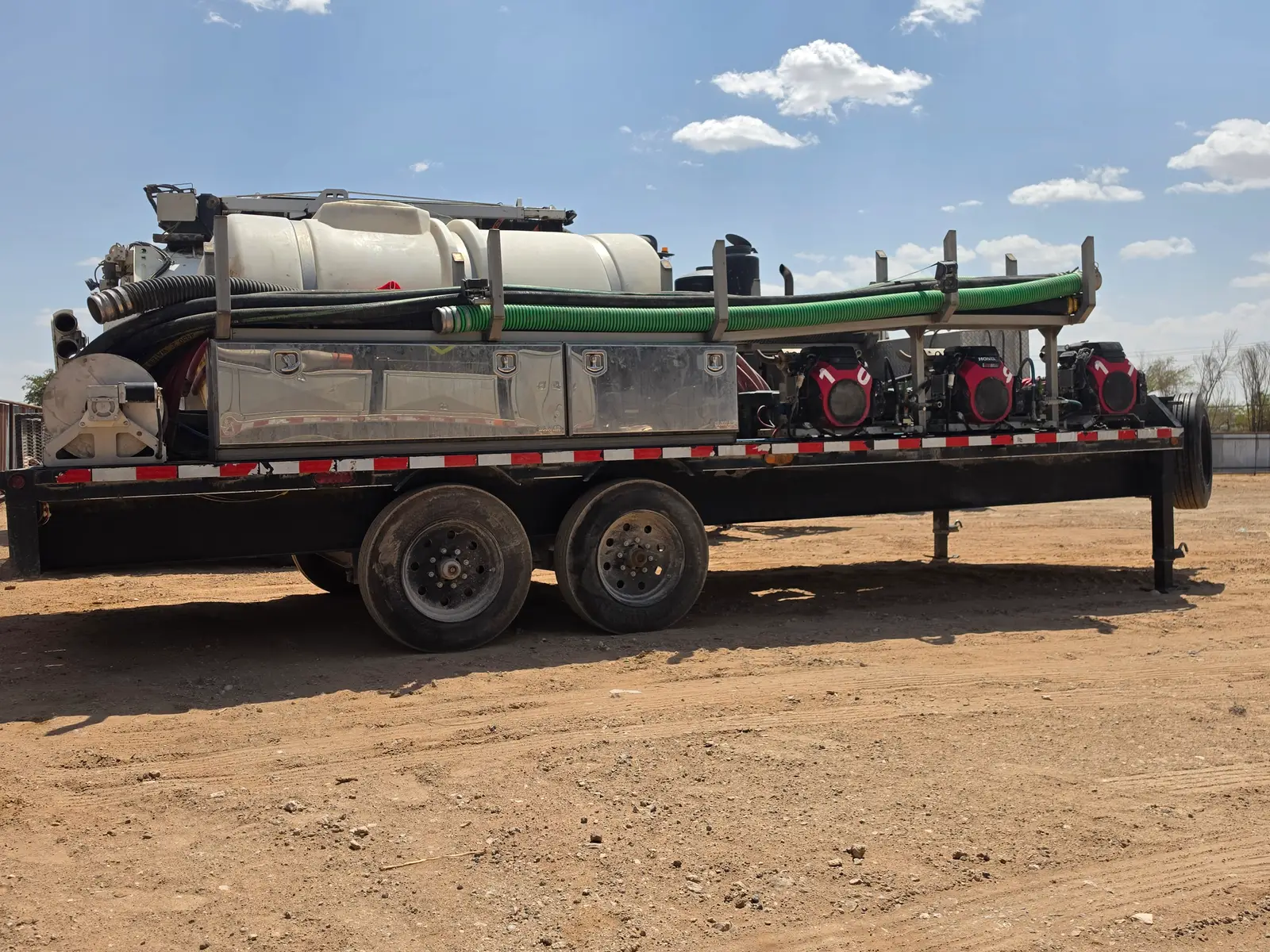
Our custom wash and jetting trailers, ready for any vessel
We could not buy equipment that cleaned a vessel properly from the outside, so we built it. Our wash trailers work a tank end to end from the manway, with the pressure and volume to move heavy solids to the outlet, no boots on the floor required. Four wands and a one-inch high-pressure jet line on each unit do the work.
Give a crew inside the vessel that much reach and that much water, and a job that used to take a full shift no longer does. Entry or non-entry, one setup does the wash and the recovery, and the tank comes back in about half the time a conventional entry clean takes.
Neither piece does it alone. The trailers wash the vessel, our modified vacuum trucks take away what comes out of it, and both were built in our own shop for this exact work. That pairing is what makes the job safer and faster at the same time: less time in the hazard, fewer hours on the invoice.

Safety & compliance
Eight years. Zero recordables.
That number is not luck. It is a jobsite safety analysis before and during every job, monthly safety meetings, GPS monitoring on our equipment, proper PPE on every task, and a method that treats the atmosphere in the vessel with 509 before anybody works it wherever H2S, LELs, or benzene are present. Those exposures, the ones that act fastest, are broken down whether or not a crew goes in. Take the worst of it out first and the job gets shorter as well as safer.
Registered in:
- ISNetworld®
- Veriforce®
Need a crew on location?
Tell us the vessel or the facility, the site, and the timeline. We will tell you what the job actually takes, what we do to the space before anyone starts, and what it costs to get it done right the first time.